
 Who is John Fotheringham?
That’s a good question! I’m not really sure if I know yet, though… Ha ha! Well, let’s see… My name is John and I’m a languaholic. I originally hail from Seattle, but have spent most of the past decade living, learning, and working in Japan, Bangladesh, China, and Taiwan. I love learning, speaking, and teaching languages, traveling the globe, making corny puns, and gaining a deeper understanding of foreign cultures through their language, people, and history. The deeper into languages I have got, the more I have come to believe that languages cannot actually be “taught”. Rather, I believe that fluency ultimately depends on how much time you have spent actively listening, speaking, reading, and writing. With this in mind, I have structured Language Mastery around the tips, tools, and tech you need to maximize your exposure to (and practice using) your target foreign tongues.
I hold a PhD in Applied Pun Making, a Master’s in Advanced Movie Quotes, and a B.A. in Linguistics from Western Washington University, with a focus on Japanese, Mandarin Chinese, and T.E.S.O.L. One of the above degrees is real; I’ll let you guess which…
How Did I Get Into Languages?
“While wandering, you experience a mysteriously organic process. It’s like a growing tree. It doesn’t know where it’s going next. A branch may grow this way or the other way. When you look back, you’ll see that this will have been an organic development.” ~ Joseph Campbell
My interest in languages—and my view on how to best learn them—has evolved organically over the past twenty years (as the following timeline shows), and continues to evolve as I learn new languages and work to retain others.
1992
I travel to São Paulo, Brazil for a 2-week home stay. This is my first time ever leaving the U.S. or having any real exposure to foreign languages (or the people who speak them). As a 12-year-old unaccompanied minor, I have to be escorted by a flight attendant while changing planes. With less than 10 minutes to run to the next plane during a connection in Rio de Janeiro, an attractive female flight attendant grabs my hand and literally pulls me down the walkway. While running, she enters into an angry diatribe for a few minutes (I can only assume it centers around her frustrations about having to look after me), at which point I finally say, “I’m sorry, I don’t speak Portuguese.” She looks at me with “you-stupid-uncultured-American” disgust, and says, “Yah, obviously.” From that moment on, I vow to learn the language of every country I visit.
1997
I do a 2-week home stay in southern France, followed by a few days to run amok in Paris. In addition to beginning a life-long addiction to pain au chocolat and quirky French films, the experience reveals two truths:
- People don’t hate the French; they hate Parisians.
- Despite two years of French language study, having a fantastic teacher, and being highly motivated, I was still wholly unprepared to speak with native French speakers. This is when I realize the inherent weaknesses of formal classroom study, boring textbooks, and focusing more on reading than speaking.
 1999
1999
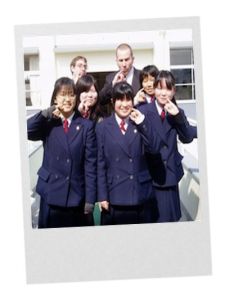
I begin studying Japanese in my second year of college. My Japanese teacher, a hilarious, zany graduate student from Japan, shows his class just how fun languages can be, and encourages me to study linguistics. My language addiction worsens…
2002
Moving on to 300-level Japanese, I am forced to take classes with the Japanese department head. She shows the class just how horrible language learning can be when it focuses on accuracy over fluency, makes students feel stupid when they make mistakes, and grades students based more on tests than projects or participation. The best thing I get out of the class is a new word: 反面教師 (“a bad example from which one can learn”).
2003
After graduating with a degree in Linguistics (which tends to be on par with Communications and Philosophy in terms of unemployability), I move to Japan to become a ninja assassin… Oh sorry, that was just the fantasy. The reality is that I join the JET Programme, and end up in a town of about 4,000 people, of which I am the only foreigner. While not exactly an epicenter for night life, the rural location does offer me an unparalleled environment for honing my language and chopstick skills. Within one year, I go from broken Japanese to fluency.
 2004
2004
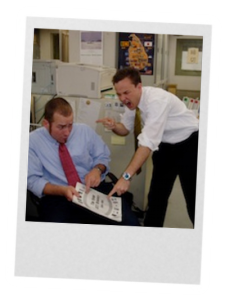
I interview to be a CIR (“Coordinator of International Relations”), land the job, and move to Kobe. My job involves translating official documents sent to and from the prefectural government, interpreting for bigwigs who visit the prefecture, and acting as an advisor to the 250 plus JET Programme English teachers working in the prefecture. The experience reveals another two truths:
- I don’t want to work as a translator or interpreter. It is a highly specialized, highly stressful job that has little to do with speaking a language well. Case in point: a few of my professional Japanese translator colleagues could translate from English to Japanese extremely well, but could barely speak English.
- If you don’t speak the local language, you will miss out on lots of interesting experiences and live a limited, stressful life. The vast majority of “I-can’t-take-it-anymore-and-want-to-go-home” calls I received from frustrated English teachers related to loneliness and not being able to communicate with local people. Had they learned Japanese, the number of potential friends would quickly expand from a few fellow English teachers to 127 million Japanese citizens.
 2006
2006
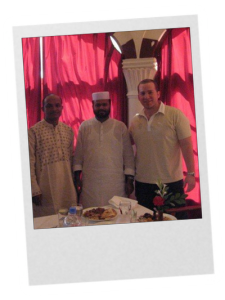
Wanting to try my hand in the business world, I spend 6 months working for a Bangladeshi start-up telecom company. Working 26 hours a day in an all-English environment, I have little time to learn Bangla unfortunately, but I do at least learn the Bangla script and pick up enough of the language to get around and build rapport with my wonderful colleagues. In addition to building a love for telecom and technology, the experience reveals two additional truths:
- Most expat professionals never even bother learning to say “Hello” in the local language, fed by equal parts laziness and arrogance. Whether you are traveling to a foreign country for work or pleasure, for the love of Pete, at least spend part of the plane ride learning to say a few basic phrases. You will be amazed how happy people are when you at least start a conversation in their language, even if you quickly fall back on English. Just think how crazy the crowd goes when a foreign rock band says “Hello Tokyo” in Japanese.
- Not everyone in the world speaks English. Other than my highly-educated colleagues and the staff at nicer hotels and restaurants, a good portion of Bangladeshis I met did not speak English well, if at all.
- Knowing even basic phrases like “I want to go to…”, “Turn right”, and “Sorry, I didn’t know she was your sister!” made all the difference.
 Mid 2006 – Mid 2009
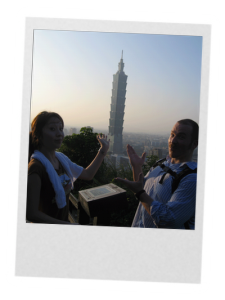
Knowing that 2000 to 2100 will be “The Chinese Century” (and in an effort to scratch my martial arts itch), I move to Taiwan to learn Mandarin Chinese. I teach business English to overworked executives and do seminars at multinationals like IBM, MediaTech, Philips, and ASUS. Two more truths come to light:
- Just as in Japan, I see that the vast majority of English learners fail to reach their fluency goals even after years (and even decades!) of formal language study. The reason? They spend almost all their time memorizing information about English, translating to and from their native language, and cramming for tests (TOEFL, IELTs, etc).
- By studying languages in such an inefficient way, it is no wonder few ever learn to speak their target tongue. And it is also no wonder why so many learners hate the process.
 Mid 2009
With new nephews to corrupt, I move back to Seattle. As much as I enjoy living abroad, who can say “no” to a picture as cute as this? 3 months old and he can already write! Talk about a linguist!
Today
I spend my time pursuing various entrepreneurial endeavors, learning languages, blogging about my addiction, and trying to be the best son, brother, and uncle I can be (you’ll have to ask my parents, siblings, and nephews how well I do!)
Future
I plan to create a complete series of language guides for the majority of major world languages. And if I can manage to afford it some day, I hope to obtain a PhD in Applied Linguistics at Victoria University of Wellington (I visited New Zealand back in 2006 and instantly fell in love with the place. I figure getting a PhD is no better excuse to live in paradise for 3 years).