
Vietnamese Loan Words and the Uniqueness of the Language

 Share/Save
Guest post by Antonio Graceffo
Antonio Graceffo is a martial arts and adventure author living in Asia (check out our interview with him here).
His books, including The Monk from Brooklyn, are available at Amazon.com
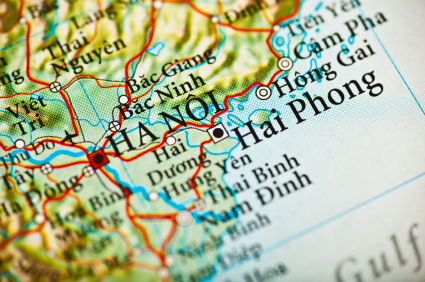 Vietnamese is one of only two major Mon-Khmer languages, the other being Khmer, the national language of Cambodia. Like Cambodia, Vietnam is a former French colony. And so, the Vietnamese language has acquired some loan words from French. I am not yet an expert on the Vietnamese language, but so far it appears that the bulk of the loan words are for concepts which the French introduced to Vietnam, such as: Nô-en (Noel), phó mát (cheese), and ca vát (neck tie).
Because of Vietnam’s close proximity to China, and a long and turbulent shared history, there is a significant Chinese influence on the Vietnamese language. Sixty percent or more of the vocabulary is Chinese. Chinese words are often easy to spot because they are one syllable words. Khmer words are normally multi-syllabic. Some Chinese words will consist of more than one Chinese character, put together, but these are compound words, and even in Vietnamese, these words would normally be written as two one-syllable words, with space between them.
Even the country name for Viet Nam is taken from Chinese, with Nam, Vietnamese for south, coming from the Chinese word for south, 南 (nán).
It is very telling to see which words in Vietnamese were borrowed from Chinese. For example, words related to education and school subjects are Chinese. History – lịch sử in Vietnamese, 歷史 (lì shǐ) in Chinese. So, the word for history is clearly a loan word, from Chinese, and the pronunciation is fairly similar. Intelligent, thông minh in Vietnamese, 聰明 (cōng míng) in Chinese. Again, it is nearly the same.
Some compound words and loan words are extremely interesting, because they combine Khmer and Chinese or Khmer and French. For example, the Vietnamese word for glove can be bao tay or găng tay. The word “tay” is the Khmer word for hand. In the first example, bao is the Chinese word for wrap, package, or cover. So, the literal meaning is a covering for your hand. In the second example, “tay” is still hand but găng is most likely the Vietnamese pronunciation for the French word for glove (gant).
Dictionary in Vietnamese is từ điển, in Chinese it is 詞典 (cí diǎn). The second syllable of both of these words is nearly identical. The first syllable is pronounced differently, but clearly comes from the same Chinese root.
Study in Vietnamese is học, and university is đại học. If the Vietnamese use Chinese characters to write the title of a university they use the same traditional characters as Taiwan or Hong Kong. Study would be written 學 And university would be written 大 學. But the interesting thing is the pronunciation. In Chinese, study is pronounced xué and university is dà xué (literally meaning “big study”). But the Vietnamese đại học, although using the same Chinese characters, would have a pronunciation much closer to Korean (대학 dae hak) than to modern Mandarin. This is most likely because the loan words in Vietnamese and Korean came centuries past, before the Mandarin dialect became standard Chinese. Another similar example is “dormitory”: ky tuc xa in Vietnamese, and 기숙사 (gi suk sa) in Korean. The Korean and Vietnamese pronunciations are quite similar. They would both use the same set of three Chinese characters, but the pronunciation would be completely different from modern spoken Mandarin, 宿舍 (sù shè).
Another example of a connection between Korean (or older Chinese) with Vietnamese would be the word for happy, hạnh phúc, as in, “I’ll be happy if someone gives me a crossbow.” The modern Chinese word for “happy” is 高興 (gāo xìng). So, it isn’t even close, but the modern Korean word 행 복 (hang bok), is almost the same.
Sometimes all three languages align. The Vietnamese word for “romantic” (lãng mạng) is almost identical to both the Chinese 浪漫 (làng màn) and the Korean 낭 만 (lang man).
Telephone, điện thoại in Vietnamese, is 電話 (diàn huà) in Chinese. In both languages the word điện means electricity. So, this character 電 (điện) appears in nearly all appliance names, in both languages. The Vietnamese word for machine is máy móc and everything from an airplane, máy bay, to a motorcycle, xe máy, includes this machine word. In Chinese, however a computer is seen as an electric appliance, 電腦 (diàn nǎo, literally “electric brain”) whereas in Vietnamese, the computer is a machine, máy tính.
While the word for motorcycle and airplane use the Vietnamese word for machine, the word for car is clearly a loan word from French, ô tô.
The Chinese word for machine is 機器 (jī qì). So, it is not similar in pronunciation to the Vietnamese word, máy. But the function is the same. Airplane, máy bay in Vietnamese is 飛機 (fēi jī) in Chinese. Both Chinese and Vietnamese create the word airplane as a compound word, composed of two syllables, written separately, one of which means “machine”. Camera is máy ảnh in Vietnamese, 照相機 (zhào xiàng jī) in Chinese. Again, the overall word for camera is different, but both Vietnamese and Chinese have created a compound word for camera which contains the respective word for machine plus the respective word for picture or photo.
Many language learners put great emphasis on words. They want to learn vocabulary, thinking that learning a language and memorizing lists of definitions is somehow the same thing. Obviously, they are nearly completely separate from each other. If you were a native speaker of French, Chinese, and Khmer learning Vietnamese, you would still need to acquire, grammar, usage, and pronunciation, as well as cultural-linguistic elements, such as forms of address and appropriateness of speech. So, even a triple native speaker would be a long way off.
Studying the mechanical parts, the elements, the words of a language is, however, an interesting academic pursuit. In the case of the Vietnamese language, it is fascinating to see how so many components of the language can be traced to some other language, and yet Vietnamese is completely unique.
____
Like Antonio’s writing?
Check out some of his fantastic books on travel, martial arts, language learning and endangered cultures.
Republishing This Article
Want to share this on your site or blog? You are welcome to republish any articles by John Fotheringham. For guest posts, you must seek permission from the post author. For John's articles, please include the following at the top and bottom of the article when reposting:
Copyright © 2010 by John Fotheringham. For more tips, tools, and tech for Mastering ANY Language, go to LanguageMastery.com
The Chinese language influences all of East Asia. Here are your examples in Japanese.
South 南 (minami, but the Chinese reading is "nan")
History 歴史 (reki-shi)
Dictionary 辞典 (ji-ten)
University 大学 (dai-gaku)
Telephone 電話 (den-wa)
Machine 機器 (ki-ki)
Airplane 飛行機 (hi-kou-ki)
yes you are right about japanese. some of the pronunciations are a bit different from chinese, like machine is ghi chi but yes, you can see the common origin, especially the chinese characters.
I really enjoyed your post, and it has started me thinking again about the big etymological picture. As a practical question, I am curious how your observations are a part of a language learning module. For example, are there any patterns or big generalizations we can make about loan words in Vietnamese vocabulary, or do you think it all case-by-case and dependent on research and experience of the individual learner? In other words, does etymology play an active role in the language learning process, or does it merely describe that fascinating academic pursuit?
I think you are asking the same question as i am "does etymology play an active role in the language learning process, or does it merely describe that fascinating academic pursuit? " Clearly with European languages it helps. if you speak Spanish, learning Italian takes about eight weeks, but somehow the cognates across Asian languages don't seem to be as helpful.
i don't think the vietnamese borrow any words from khmer, they have no power to influence to vietnamese
not only did vietnamese borrow from khmer, vietnamese is a Monkhmer language and there are a lot of cognates.
Actually whether or not Vietnamese is Mon-Khmer or not is still being disputed.
Yes, Vietnamese borrows some French words such as ca-vát/cà-vạt (a tie), cà-phê (coffee), cao-su (rubber), xà-phòng/xà-bông (soap) etc… but the amount of Chinese loanwords is enormous and as you said equates to at least 50-60% of the Vietnamese words, not counting those older borrowings that were nativised such as năm/niên (year), mùi/vị (flavour), sắt/thiết (iron) etc.
Vietnamese borrowed and shares a lot of words with Khmer. Con, cháu are just to name 2.
I am more familiar with french loan words in Khmer. where many words are clearly concepts the Khmers didnt have before the french came. for example: cheese, christmas, magazine, but for some reason a lot of science words and political words, higher words, were replaced by French words, although there is a perfectly good khmer word being used in thailand. in vietnam, the french words were very few and all clearly french concepts like cheese, but th chinese words spanned a huge gamot. education words, like schools and subjects, are all chinese, which makes sense because the chinese culture is so pro education, but also words for police and public safety, traffic…a lot of words are chinese. in fact it may be as much as 60%. so why those words are chosen i am not sure. i need to do more research and study when i go back to vietnam.
Check out this paper: http://www.vny2k.com/vny2k/SiniticVietnamese.htm
And about hạnh phúc – it is 幸福 in Chinese.
By the way, which atlas did you use for your picture? It looks like it's from the DK Atlas or one of its derivatives.
Modern Vietnamese is the result of thousands of years of continual contact between the Kinh (Viet) and surrounding peoples, most notably the Chinese. Just out of the top of my head, if you gave me a pen and paper, I could write down at least 1-1500 different Chinese syllables that were loaned to Vietnamese. Many modern technical, scientific, higher vocabulary in general are of Chinese or Japanese-made-Chinese origin. These include things like xã-hội (society), công-ty (company), nhạc-hội (concert), đại-học (university), hiệu-trưởng (school principal/headmaster) etc…
I'd just like to add to some of the terms you mentioned in your awesome article! I think you made a mix up when you said that most Chinese loanwords were of 1 syllable and Mon-Khmer loanwords were of 2 syllables. It is the other way around
Also, it is not ideal to use Mandarin as a comparison for the Chinese loanwords as it has had massive sound changes (as you yourself noticed!) A more ideal comparison would be to Cantonese. For example, 大學/大学 as you mentioned is đại-học in Vietnamese, 대학 dae-hak in Korean, 大学 dai-gaku in Japanese and 大學 dai-hok in Cantonese. Mandarin has merged many sounds and lost the -p, -k, -t endings.
Yes there are plenty of terms with one Chinese syllable and 1 native or other loanword one. Bao tay, bánh bao, cao máu etc…
A car in Vietnamese depending on region is either (xe) ô-tô or xe (hơi). Machinery in general have 2 terms; máy móc (native) or the loaned cơ khí from Chinese. An airplane is either máy bay or phi cơ. A camera is either máy (chụp) ảnh or máy chụp hình.
Vietnamese and Khmer share some cognates but out and out calling the Vietnamese language a mixture of "Khmer and Chinese and French" is just hilarious.
That the language family is called "mon-khmer" to begin with is due to westerners naming it so, not that Vietnamese is just an offshoot of Khmer.
Vietnamese is a Monk Khmer language, you could verify that with thirty seconds of research. I speak Khmer and am currently a full-time student at university in Saigon and without a doubt, Vietnamese is a Mon Khmer language. I don't know that i claimed Vietnamese is a mix of the three languages, i said it had cognates from all three, whereby more than half the vocabulary is from Chinese. I never claimed that Vietnamese was an off-shoo of Khmer. I claimed that they are both in the same language family, which they are. If you have research to the contrary, please share it with us.