
The Secret to Learning a Language in 10 Days

Check out this beautifully illustrated talk about how to learn foreign languages using the Pimsleur approach. I was reluctant to share the video on the site as they sneak in a sales pitch every 5 minutes of so, but they do an excellent job of summarizing what I believe to be the fundamentals of effective language learning, with pretty drawings to boot! Enjoy!
read moreHow to Conquer Kanji

Kanji: arguably the most enjoyable part of learning Japanese, but also the most intimidating for those just getting started in the language. Since beginning my Japanese journey over a decade ago, I have come across a lot of Nihongo teachers, textbooks, and courses that advise learners to hold off on kanji until they already speak the language fairly well. I think this is absolute rubbish, but let me first give some of the common arguments before I tear them to shreds...
read moreInterview with Arkady Zilberman, Creator of Language Bridge

Arkady Zilberman, creator of Language Bridge and a former simultaneous interpreter in Russia, addresses what is perhaps the greatest impediment to adult language learning success: cross-translation to and from one's native language. Few learners are probably aware this sub-concious process goes on at all, but Arkady's extensive experience learning languages, interpreting, and experimenting on learners, have proven that it does indeed occur. As he points out in our interview, even many seemingly successful foreign language learners still translate to and from their native language, but can just do so at such a rate that they can't perceive the process.
read moreThe Polyglot Project

The Polyglot Project, a collection of language learning tips from polyglots and language enthusiasts across the globe (including yours truly), is now available as both a physical book on Amazon and as a free PDF download. This tome of language awesomeness contains over 500 pages of language learning advice, tips, and success stories, with contributions from 43 authors, including Moses McCormick, Steve Kaufmann, Benny Lewis, Stuart Jay Raj, and countless others language heroes.
read moreThe Input vs. Output Debate: John’s 2¢

As a language learning addict, I follow lots (and I mean lots) of polyglot blogs and podcasts. It is always interesting to see what has worked (and what hasn't worked) for successful language learners. While most fluent foreign language speakers tend to agree on the vast majority of language learning DOs and DON'Ts, there is one area that always seems to cause heated debate, shouting, name calling, and occasional mud/poo flinging: the importance of language input (i.e. listening and reading) versus language output (i.e. speaking and writing). I have sat quietly on the sidelines for some time now, politely listening to both sides of the argument. But it's time to blow my referee whistle because both teams are "offsides" (Okay John, enough sports analogies already!)
read moreIs That Word Difficult or Just Unfamiliar?

I often hear English learners and English native speakers alike complain that certain English words are “difficult” (in fact, I’ve heard the same thing said by native and non-native speakers of Japanese and Mandarin Chinese, too). Consider the words shoe and happy. Are these English words difficult? To you and I, these terms are probably as easy and basic as they get. But what about for a 6-month old American child? Or what about for a hunter-gatherer living deep in the Amazonian rain forest who has never heard a word of English spoken or seen any English writing? For...
read moreThe Critical Difference Between “Studying” and “Learning” a Language

I am often asked if there any tricks or shortcuts to learning a language more quickly. I always respond with the same answer: "The trick to learning a language is to actually learn the language." This may sound obvious, but it points to the fundamental (and so often under-appreciated) reason why most adults fail to learn a foreign language no matter how many years they sit in a classroom or live where the language is spoken: Most adult learners spend nearly all of their study time reading and learning about their target language, with very little time truly listening to or reading in the language.
read moreInterview with Randy the Yearlyglot of Fluent Every Year

Randy is on a mission to learn a new language fluently every year. His current project is Italian, with Lithuanian as a side-project saved for weekend fun. Randy has his language-learning head screwed on tightly, and I firmly agree with his contention that learners can reach "conversational fluency" (the ability to talk with native speakers on a variety of topics) in a year if you spend enough time doing the right things. As we both have observed, most learners neither spend enough time nor do the right things.
read moreForeign Language Mastery Featured in the Get-it-Done Guy Podcast

Stever Robbins (a.k.a. The Get-it-done Guy), author of The Get-it-Done Guy's 9 Steps to Work Less and Do More, has featured my language learning tips in the June 7, 2010 episode of his popular productivity podcast. As Stever points out in the episode's introduction, "I have enough trouble with my own language. Tips on foreign language?!? Don't make me laugh! Fortunately, John Fotheringham of LanguageMastery.com came bounding to the rescue and sent in all the following tips on how to learn a language quickly." Thank you, Stever!
read moreShowing Up is the Key (Guest Post by Khatzumoto of AJATT)

OK. Everyone knows that quote by Woody Allen or whoever about showing up. You know, 70% of winning is showing up. Well, Woody Allen, that daughter-dating scoundrel, lied to you. The truth is 70% of winning is showing up is a bunch of bull!
read moreJoin the Oh So Hip Foreign Language Mastery Newsletter
Top 5 Reasons to Join
1. It's free.
2. Your information will NEVER be shared with anyone. I hate spam as much as you.
3. You'll get exclusive language learning tips.
4. All the cool kids are doing it.
5. You'll get 2 bombtastic bonuses:
Bonus 1:
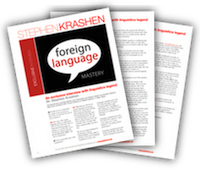
My exclusive interview with renowned linguist Dr. Stephen Krashen.
Bonus 2:
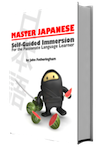 25% off Master Japanese: Self-Guided Immersion for the Passionate Language Learner.
Learn Japanese Your Way

Let's face it: textbooks are boring, Japanese classes are less than convenient, those language courses sold in airports are ridiculously expensive, and not everyone can move to Japan.
The good news is that you don't need any of these things to learn Japanese. The modern language learner has access to everything they need to learn via the Internet (including materials, tools, and native speakers), but the hard part is knowing where to look, where to start, and how to stay the course. That's where Master Japanese comes in.


The 309-page, 75,000+ word guide provides:
1) Step-by-step instructions on how to get started.
2) Pragmatic strategies for fostering and sustaining motivation.
3) Learning languages the way our brains were designed.
4) The world's best online and offline tools for learning Japanese fast.
5) How to create a Japanese immersion environment no matter where you happen to live.
6) Clickable links to all online resources so you don't have to waste time Googling or typing in URLs
7) Print-ready cheat sheets and templates for making goals, studying kanji, learning conjugations, and more.
